
Introduction
The world’s energy infrastructure is getting smarter, greener, and safer. Dry-type systems that use modern materials, smart cooling, and safety that doesn’t leak are taking the role of traditional oil-filled transformers. This article talks about how current dry-type transformers work and why they are the best choice for next-generation power networks.
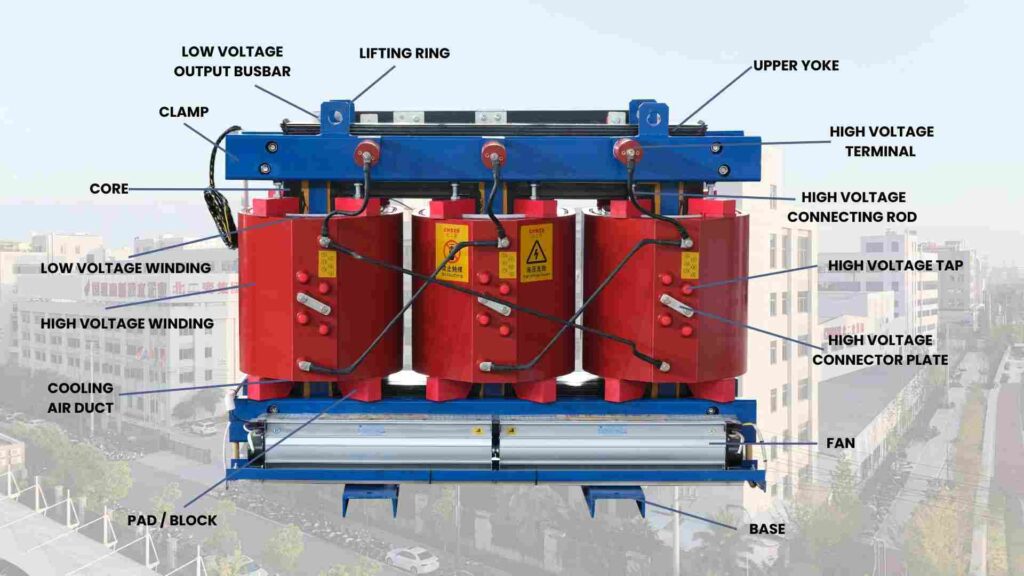
Core Mechanism: The Science of Oil-Free Insulation and Induction
Modern dry-type transformers don’t need oil to cool or insulate them anymore. Instead, they use air circulation, solid insulation, and computerized design tools to get the same magnetic induction process, but with far better safety and environmental performance.
Basic Idea: How Electromagnetic Induction Works in Dry Type Units
These transformers still work according to Faraday’s Law of Electromagnetic Induction1, which says that voltage changes as magnetic flux changes. But what makes this new is how engineers now manage and improve that flow.
Designers can use 3D finite element magnetic simulations to make small changes to the shape of silicon-steel laminations to reduce hysteresis and eddy current losses. Intelligent monitoring sensors keep an eye on temperature and magnetic performance in real time. This lets the transformer change the speed of the fan and the cooling cycles on its own.
This real-time feedback loop cuts down on energy loss by up to 15% in smart grids and renewable energy systems compared to standard dry-type devices.
The Insulation Secret: Comparing VPI vs. Cast Resin Winding Technologies

Both VPI and Cast Resin are still the major parts of dry-type insulation, however new eco-materials are changing them.
VPI (Vacuum Pressure Impregnation): Solvent varnishes have been replaced with advanced water-based or low-VOC resins, which makes production cleaner and more environmentally friendly. This means less pollution and longer insulation life.
Cast Resin (Epoxy Encapsulated): Manufacturers now utilize epoxy systems loaded with nano-silica that have better thermal conductivity, which makes them better at heat dissipation and mechanical strength. Some also apply graphene coatings to improve dielectric performance and resistance to partial discharge.
These modifications turn what used to be a simple insulation technique into a protection system designed to last, even under extreme humidity or vibration.
| Feature | Traditional Design | Next-Generation Improvement |
|---|---|---|
| Resin Material | Standard epoxy | Nano-filled, eco-friendly epoxy |
| Dielectric Strength | Stable | Enhanced (graphene coating) |
| Environmental Impact | Medium | Low (VOC-free varnish) |
| Thermal Conductivity | Moderate | High |
| Lifecycle | 20 years | 30+ years |
Engineering Excellence: Design Strategies for Fire Safety, Efficiency, and Low Maintenance
These days, dry-type transformers are built with long-term performance and sustainability in mind. Modern engineering combines fire safety, efficiency, and digital monitoring into one system.
Thermal Management: ONAN and ONAF Systems for Heat Dissipation
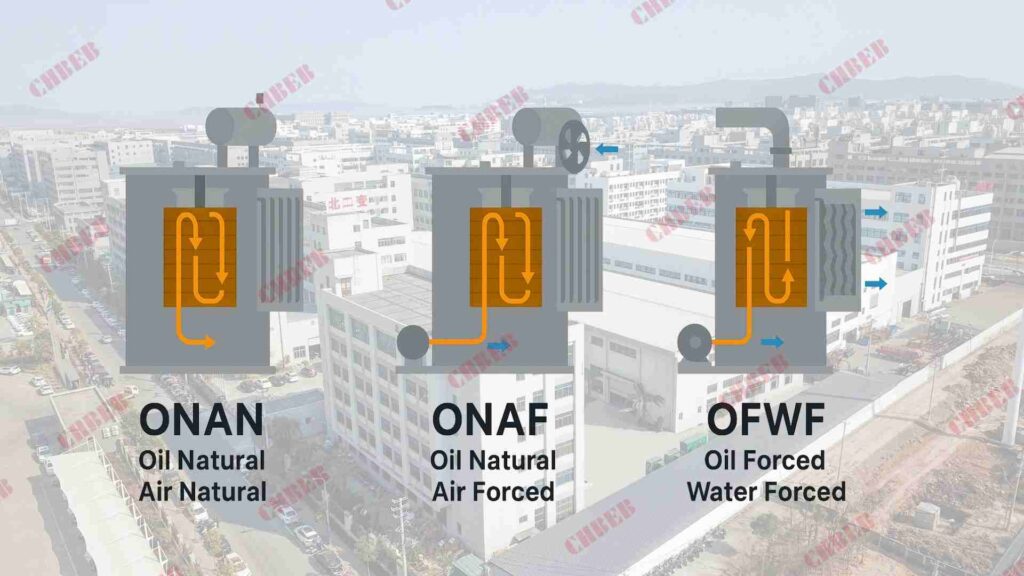
The old ONAN and ONAF cooling methods have become smart thermal management systems.
ONAN (Air-Natural): CFD (Computational Fluid Dynamics) is used to simulate airflow channels so that cooling is even without fans.
ONAF (Air-Forced): Smart fans only turn on when temperature sensors detect a certain level, which saves energy.
AI-based temperature controllers analyze historical data to predict when cooling is needed. This makes fan cycles more efficient and extends bearing life. The end result is quieter, more efficient, and longer-lasting transformers that meet the IEC 60076-112 thermal performance standards.
Value Conversion: Engineering the Fire-Proof, Eco-Friendly, and Maintenance-Free Advantages
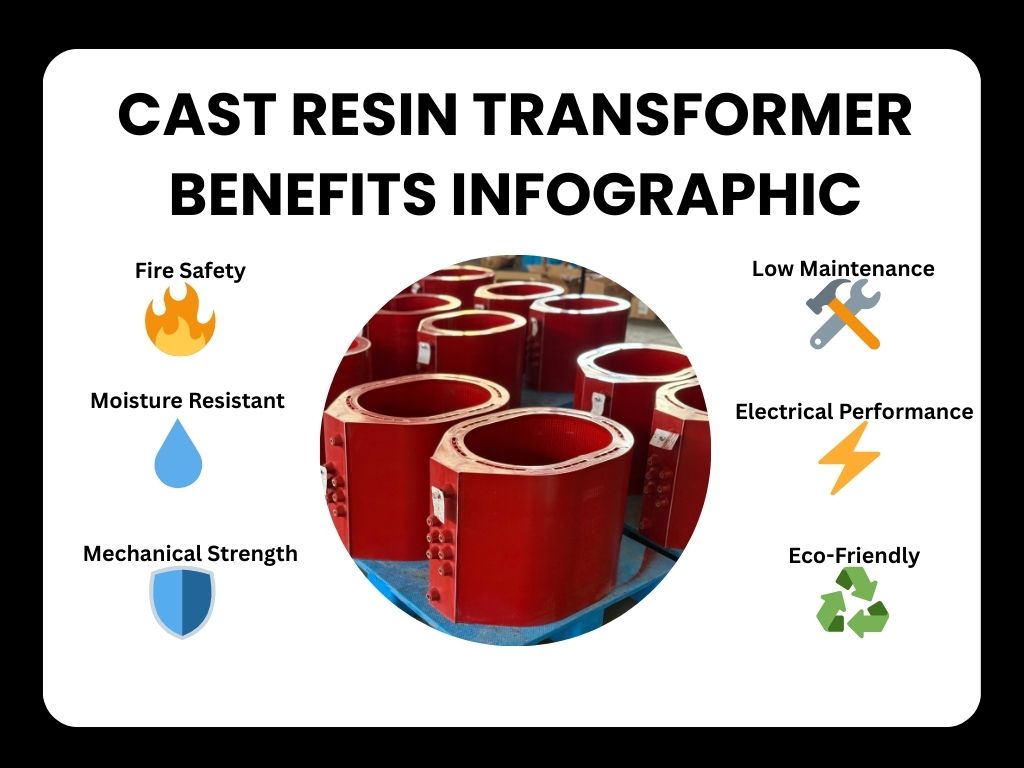
Today’s dry-type transformers are an example of the move toward designs that are safe against fire and good for the environment.
- Fire Safety: Class F or H fire classifications say that solid epoxy insulation and self-extinguishing materials lower the possibility of oil catching fire.
- Environmental Sustainability: Oil-free operation eliminates leaks and soil contamination, and insulation systems that may be recycled follow ISO 14001 standards.
- Energy Efficiency: Amorphous or nano-crystalline steel, step-lap joints, and precision core cutting cut no-load losses by 20–30%.
- No need for oil means no need for filter, sampling, or containment pits. Just clean the air and scan it using infrared thermal imaging every once in a while.
Dry-type units are now a key part of sustainable energy systems since they are changing from traditional insulation to smart eco-design.
Selection & Limitations: When and Where to Choose Dry Type Units
Dry-type transformers are not universal, even if they have some benefits. Their real worth comes from specific applications where safety, sustainability, and reliability are more important than high capacity.
Application Positioning: The Best Way to Choose Between Oil-Immersed Transformers and Other Options
When to use dry-type transformers:
- The installation site is within or in a busy city area, like a hospital, subway station, or commercial tower.
- There are tight rules on fire safety and environmental protection.
- The project needs IoT-based monitoring or integration with smart-grid technology.
- You want equipment that lasts long, needs little maintenance, and has a low carbon footprint.
Continue using oil-immersed units when:
- The transformer’s voltage rating is more than 35 kV or its capacity is higher than 5000 kVA.
- The place where the installation will take place is completely outside, has natural ventilation, and is not very likely to catch fire.
- The most important thing is the initial CAPEX, and maintenance crews are always on hand.
| Comparison Aspect | Modern Dry Type | Oil-Immersed |
|---|---|---|
| Fire Safety | Self-extinguishing | Requires fire barriers |
| Monitoring | IoT & thermal sensors | Manual inspection |
| Eco Impact | Zero leakage | Oil waste risk |
| Efficiency | High (IEC Tier 2) | Medium |
| Typical Use | Smart grids, renewables, buildings | High-capacity substations |
Engineers can make sure that modern infrastructure meets its sustainability and digitalization goals by making sure that these design and operational variances fit the needs of the project.
⚙️ CHBEB — Reliable Partner for Distribution Transformers

When engineers ask how dry-type transformers dissipate heat efficiently, why solid insulation works without oil, or which design—VPI or Cast Resin—performs better in humid climates, CHBEB provides not just answers but proven solutions built from over 60 years of engineering experience.
As one of China’s leading distribution transformer manufacturers, CHBEB integrates real-world testing, research, and client feedback directly into its production systems. Each dry-type transformer, from 50 kVA to 5000 kVA, is designed with the same precision that addresses the very questions engineers and project managers raise every day:
- Smart Cooling Design: Optimized ONAN/ONAF airflow and digital temperature monitoring ensure stable thermal performance even under fluctuating loads.
- Advanced Insulation Systems: Both VPI and Cast Resin series use 100 % new copper, nano-enhanced resin, and high-grade silicon steel—guaranteeing long-term dielectric reliability without oil.
- Proven Capacity & Durability: Factory-tested under IEC 60076 and ISO 9001 standards, CHBEB transformers operate reliably in demanding industrial and commercial networks.
- Maintenance-Free Operation: Every unit is designed for real-world practicality—no oil changes, no leak checks, just clean, efficient power delivery for 25 years +.
With two production bases in Wenzhou, one in Nanjing, and a technical office in Beijing, CHBEB combines Chinese manufacturing strength with global quality standards. Its products serve power utilities, EPC contractors, and industrial facilities across Russia, Southeast Asia, Africa, and Belt and Road countries.
For every question engineers ask—about cooling, insulation, capacity, or reliability—CHBEB’s answer is the same: tested technology, certified performance, and delivery that never misses a deadline.
👉 Looking for a distribution transformer manufacturer that combines Chinese manufacturing strength with international standards?Contact CHBEB for a tailored solution or Download our full transformer catalog here.
Frequently Asked Questions (FAQ)
1. How does a dry-type transformer dissipate heat?
Dry-type transformers use air as the main cooling medium. Heat from the windings and core moves outward through natural air circulation (AN) or forced air (AF) using fans. Modern models use CFD-designed air ducts and temperature sensors to maintain uniform thermal balance without oil.
2. Why can a dry-type transformer insulate without oil?
Instead of liquid insulation, they use solid dielectric materials such as epoxy resin, varnish, or fiberglass. These materials provide high dielectric strength and thermal endurance, preventing short circuits and partial discharges even in humid environments.
3. What is the difference between VPI and Cast Resin dry-type transformers?
VPI (Vacuum Pressure Impregnation) uses varnish under vacuum and pressure, producing a protective film.
Cast Resin transformers encapsulate windings in solid epoxy.
- VPI: Lower cost, easier to repair.
- Cast Resin: Better moisture and fire resistance, ideal for coastal or critical sites.
4. Do dry-type transformers work on the same principle as oil-immersed transformers?
Yes — both rely on Faraday’s Law of Electromagnetic Induction. The difference lies only in cooling and insulation: oil-immersed units use oil for both, while dry types use air and solid insulation for safer indoor use.
5. What is the maximum capacity of a dry-type transformer?
Standard dry-type transformers are typically available up to 5000 kVA and voltage levels up to 35 kV. Beyond that, oil-immersed transformers are preferred for thermal and economic reasons.
6. Are dry-type transformers really maintenance-free?
Yes, compared to oil units. They need no oil filtration, sampling, or leak checks — only periodic cleaning, ventilation inspection, and infrared temperature scanning. With proper airflow and environment, service life can exceed 25–30 years.
Conclusion
Dry-type transformers have evolved from simple oil-free devices into intelligent, eco-engineered power solutions. Using advanced insulation, smart air-cooling systems, and digital condition monitoring, they now deliver higher efficiency, safer operation, and sustainable performance across industries.
Every question engineers commonly ask — from how dry-type transformers dissipate heat to why solid insulation works without oil — finds its answer in real-world engineering and decades of testing. These technologies are not just theoretical concepts; they are field-proven solutions that power today’s smart grids, renewable projects, and industrial facilities with reliability and precision.
Backed by over 60 years of transformer manufacturing expertise, CHBEB continues to drive this evolution with IEC 60076-compliant dry-type designs, advanced VPI and Cast Resin technologies, and rigorous quality control from material selection to final testing. From smart cooling systems to precision core engineering, every CHBEB transformer represents the fusion of safety, efficiency, and innovation.
As global energy systems move toward sustainability and digital automation, CHBEB remains committed to delivering reliable power distribution solutions that set new standards for performance and trust — transforming engineering expertise into long-term value for clients worldwide.