Send us a message if you have any questions or request a quote. Our experts will give you a reply within 24 hours and help you select the right valve you want.
A distribution transformer is a static electrical device used in power distribution systems that transfers AC power by transforming voltage and current based on the law of electromagnetic induction. It typically operates at voltage levels of 10–35kV (mostly 10kV and below) with a capacity of 6,300 kVA or less, supplying power directly to end users. As a core component of the “last mile” of power delivery, distribution transformers are found in residential areas, industrial facilities, commercial buildings, and rural power grids around the world.
In this article, we cover everything you need to know about distribution transformers — from how they work and their key components, to the different types available and how to choose the right one for your project.
Basic Introductionransformer?
1. Definition
A distribution transformer is a static electrical device in a power distribution system that transforms AC voltage and current to transmit AC power, based on the law of electromagnetic induction. In some regions, power transformers operating below 35kV (mostly 10kV and below) are referred to as “distribution transformers.” Locations where distribution transformers are installed are considered substations. Distribution transformers are typically mounted on poles or installed outdoors at ground level.
2. Difference from Power Transformers
The main difference between power transformers and distribution transformers lies in the voltage levels they handle.
Power transformers are used in transmission systems, operating at high voltage levels. Their primary role is to step down the high voltage delivered by the grid to levels suitable for power companies or industrial users. They generally do not have load regulation capability.
Distribution transformers operate in distribution systems at medium-to-low voltage levels. They step down the voltage from high-voltage lines to the lower voltages required by homes and businesses, and typically have some degree of load regulation capability.
Compared to power transformers, distribution transformers are smaller, lighter, and easier to relocate, making them better suited for installation in urban and residential areas.
Basic Structure of a Distribution Transformer
A distribution transformer consists of three main components: the iron core, the windings, and the insulating oil. The windings form the electrical circuit, while the iron core forms the magnetic circuit. Together, they make up the core electromagnetic section of the transformer.
1. Iron Core
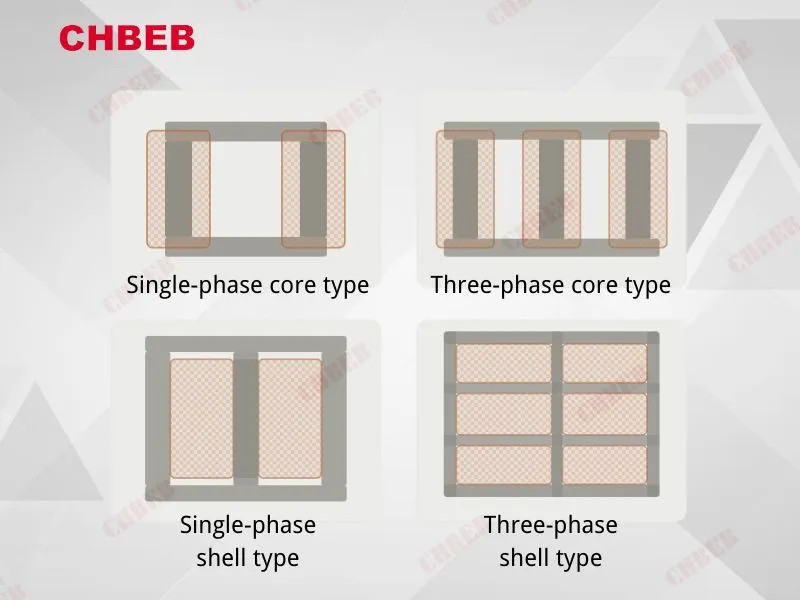
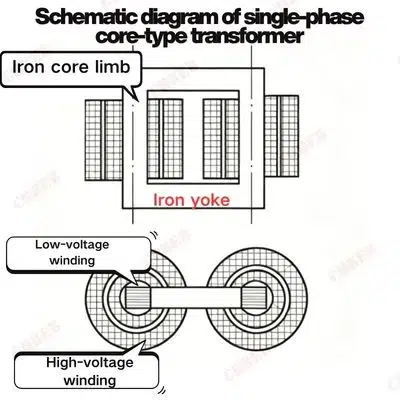
The iron core is one of the fundamental components of a transformer. It serves as the main magnetic circuit, providing both the primary magnetic flux path and the mechanical framework for the transformer body. It is typically made by stacking hot-rolled or cold-rolled silicon steel sheets with a thickness of 0.35 or 0.5mm and an insulating coating on the surface. The iron core is divided into two parts: the core limb (which holds the windings) and the yoke (which closes the magnetic circuit).
By structure:
Core type — Simple structure, easy to manufacture, widely used.
Shell type — More complex structure, used in small-capacity transformers and furnace transformers.
By material:
Silicon steel sheets
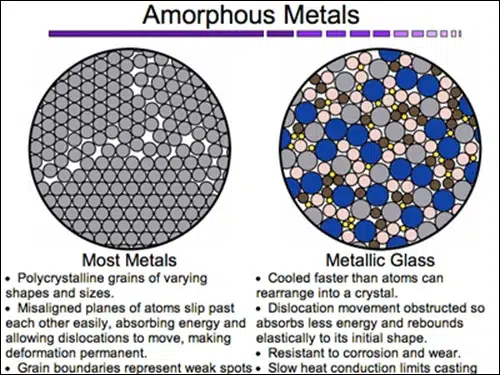
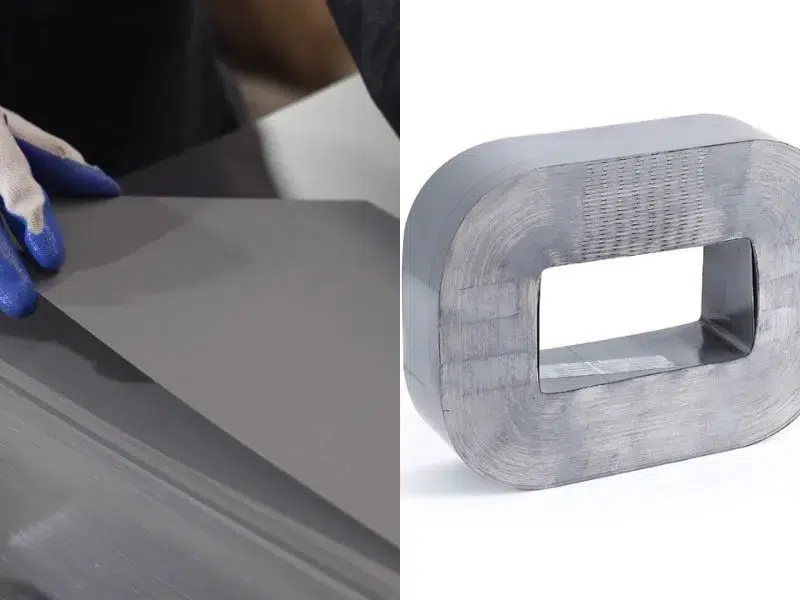
Amorphous alloy — Produced through ultra-rapid solidification, where atoms do not arrange into a crystalline structure. Transformers with amorphous alloy cores reduce no-load losses by around 75% and no-load current by around 80% compared to silicon steel core units. They are currently one of the most energy-efficient distribution transformer options available.
By assembly process:
Stacked type
Wound type
2. Windings
The windings are the electrical circuit part of the transformer, generally wound on a winding form using insulated flat copper wire or round copper wire. The windings are fitted onto the transformer core limbs, with the low-voltage winding on the inside and the high-voltage winding on the outside. Insulating sleeves are placed between the low-voltage winding and the core, and between the high-voltage and low-voltage windings. There are two basic winding arrangements:
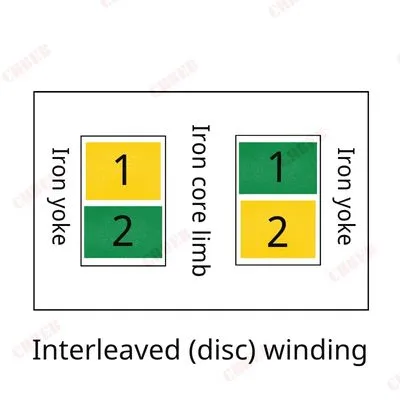
(1) Interleaved (Disc) Winding
Both high- and low-voltage windings are divided into several disc coils arranged alternately along the height of the core limb. Commonly used in shell-type transformers.
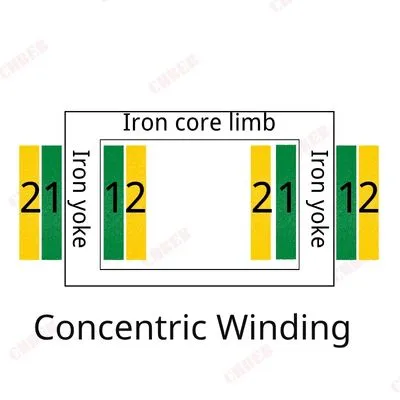
(2) Concentric Winding
Both windings are made into cylindrical shapes with different diameters and placed coaxially on the core limb. Concentric windings can be further divided into:
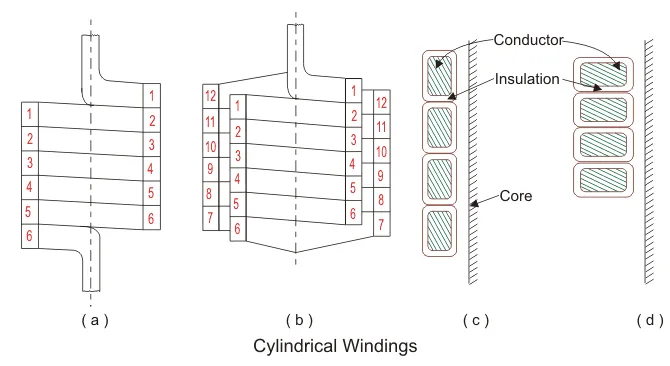
Cylindrical winding — The simplest type, wound continuously along the core height with interlayer insulation paper between layers. Generally used for low-voltage windings in small-capacity transformers.
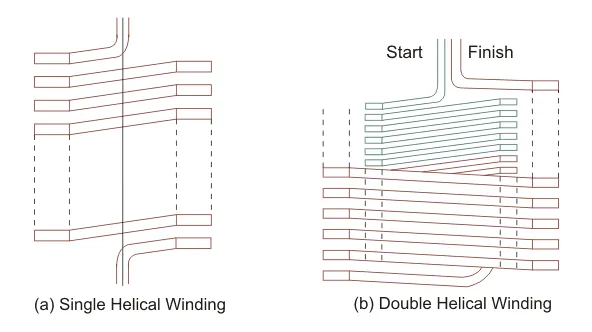
Helical winding — Multiple insulated flat conductors arranged in parallel radially, wound helically along the core axis, with each turn resembling a disc coil.
Continuous winding — Multiple disc coils wound continuously with flat conductors, connected alternately at the inner and outer sides without any joints.
Interleaved winding — Similar in appearance to continuous winding, but electrically adjacent turns are interleaved with other turns from the winding.
3. Bushings
Bushings are the insulating supports for the transformer’s lead-out conductors. They not only provide insulation between the conductors and ground, but also physically secure the lead-out conductors in place. Transformer bushings must have high electrical strength, mechanical strength, and good thermal stability.
4. Tap Changer
The tap changer is the voltage regulation component of a distribution transformer, used to keep the output voltage within a specified range. It works by changing the turns ratio of the primary and secondary windings to adjust the output voltage. There are two types:
No-load tap changer (off-circuit) — Switches winding taps with the transformer de-energized. Typically operated manually.
On-load tap changer — Allows voltage adjustment while the transformer remains in service without interruption.
Common Types and Applications
Based on cooling method, distribution transformers are divided into oil-immersed and dry-type. Oil-immersed transformers use oil as the cooling medium — including oil-immersed self-cooled, air-cooled, water-cooled, and forced oil circulation types. Dry-type transformers use natural air convection or forced fan cooling, and are commonly used in high-rise buildings, highway toll stations, local lighting, and small-capacity electronic applications.
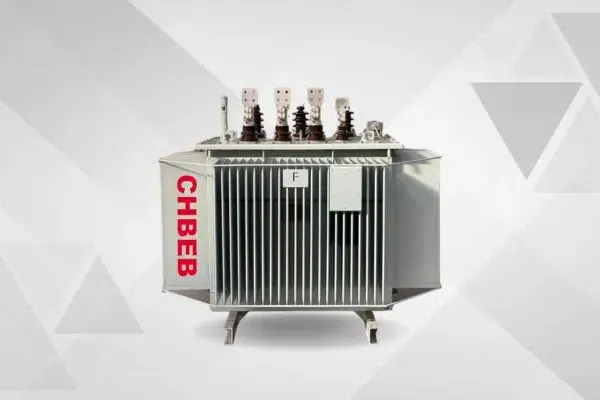
1. Oil-Immersed Distribution Transformer
Oil-immersed distribution transformers are key equipment in power supply and distribution systems for industrial, mining, and civil construction applications. They step down network voltages of 10(6)kV or 35kV to the 230/400V busbar voltage used by end users. These products are suitable for 50(60)Hz AC, with a maximum three-phase rated capacity of 2,500 kVA. They can be used indoors or outdoors, and units of 315 kVA or below can be pole-mounted.
Operating conditions:
Ambient temperature: −25°C to +40°C
Relative humidity: not exceeding 90% (at 25°C)
Altitude: not exceeding 1,000m
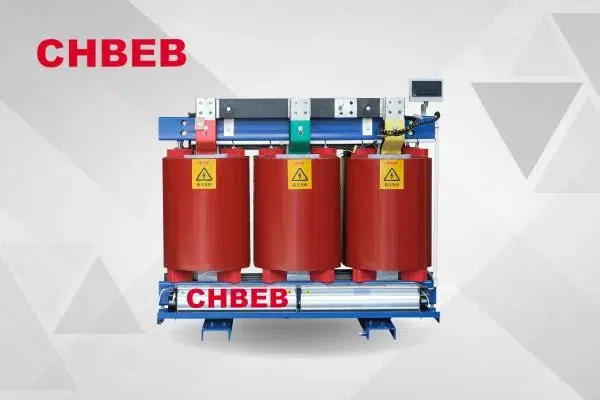
2. Dry-Type Distribution Transformer
Dry-type transformers are widely used in local lighting, high-rise buildings, airports, docks, CNC machinery, and similar applications. The core and windings are not immersed in insulating oil. Cooling methods include:
Natural air cooling (AN) — The transformer can run continuously at rated capacity for extended periods.
Forced air cooling (AF) — Output capacity can be increased by 50%. Prolonged continuous overload should be avoided as it drives the unit into an uneconomical operating state.
Technical Parameters
The main technical parameters of a distribution transformer include:
Parameter
Description
Number of phases
Single-phase or three-phase configuration
Rated frequency
Operating frequency, typically 50Hz or 60Hz
Rated capacity
Maximum output power, expressed in kVA
Rated voltage
Primary and secondary voltage levels, e.g. 10(6)kV / 0.4kV
Rated current
Current at rated capacity on primary and secondary sides
Impedance voltage
Short-circuit impedance, expressed as a percentage
Load loss
Power loss when carrying rated load, expressed in watts
No-load current
Current drawn with no load connected, as % of rated current
No-load loss
Power loss in the core when energized with no load
Connection group
Winding connection configuration, e.g. Dyn11, Yyn0
How to Get a High-Quality Distribution Transformer?
When it comes to sourcing a reliable distribution transformer, choosing the right manufacturer makes all the difference. At CHBEB, we have been designing and producing distribution transformers for decades, supplying both China’s State Grid and customers across the globe.
Our transformers are built to meet the strict procurement standards of State Grid Corporation of China — one of the world’s largest and most demanding power networks. This long-term partnership is a direct reflection of our product quality, manufacturing consistency, and engineering capability.
Over the years, we have also expanded our reach to international markets, delivering distribution transformers to utilities, industrial facilities, and infrastructure projects in Asia, the Middle East, Africa, Europe, and beyond. Every unit we produce goes through rigorous testing and quality control before it leaves our factory.
Whether you need an oil-immersed transformer for outdoor substation use, a dry-type unit for indoor installation, or a custom solution built to your exact specifications, CHBEB has the experience and capacity to deliver.
Explore our distribution transformer product range:
Contact us today to discuss your project requirements or request a free quote.
Conclusion
Though transformers sit quietly in the corner of a substation, they are the heart of any high and low voltage power distribution system. Choose the right transformer, and your project starts ahead on both power supply safety and efficiency.
FAQ
How do I choose the right capacity for a distribution transformer?
When selecting a distribution transformer, performance aside, capacity must be chosen carefully based on actual load size to ensure proper load utilization. Oversized capacity means higher purchase costs and greater upfront investment, and the fixed no-load losses during operation will also be higher. Undersized capacity not only fails to meet power demands but also tends to result in higher load losses.
How many transformers should I install, and how do I decide?
The number of units should generally be determined from both a safety and economic standpoint. Where there are large amounts of first-tier loads, or second-tier loads that require backup from a security perspective, or where load fluctuations are large with long intervals, a combination of one larger and one smaller unit can be considered. When high supply reliability is required, a standby transformer should be included. Site conditions and other factors also play a role. Where power and lighting share a single transformer and this seriously affects lamp life or lighting quality, a dedicated lighting transformer should be installed.
What is the optimal load rate for efficient transformer operation?
Transformer efficiency is highest when no-load losses equal load losses, though this is difficult to achieve in practice. Economic and optimal economic operating curves should be considered during operation. Generally, a transformer load rate of 45%–75% delivers higher efficiency and is more economical overall. However, this varies by transformer capacity and type and should be assessed accordingly. Reference can be made to Professor Hu Jingsheng’s work on transformer economic operation for detailed calculations and guidance.
Why is reactive power compensation important for distribution transformers?
Reactive power compensation must be neither excessive nor insufficient. The actual power factor of a distribution transformer should generally reach 90% or above, and the losses introduced by the capacitors themselves must be factored in. Proper compensation allows businesses to achieve significant energy savings. The benefits include improved power factor, reduced line losses, and improved operating voltage. Compensation can be applied in groups, centrally, or locally.
How do I select the right output voltage and tap changer setting?
When selecting and using a transformer, attention must be paid to the secondary output voltage. The overall system voltage conditions should be fully considered when choosing the appropriate turns ratio and tap changer position, so as to meet the voltage quality requirements of the end user.
Hello! 👋 Welcome to CHBEB.
We are a transformer manufacturer with 60+ years of experience.
✅ Distribution & Power Transformers (Oil & Dry Type)
✅ Customized EPC & OEM Solutions
✅ Fast Delivery & International Certifications