Send us a message if you have any questions or request a quote. Our experts will give you a reply within 24 hours and help you select the right valve you want.
Introduction: An isolation transformer is a special type of transformer whose main function is to isolate the input circuit from the output circuit, helping protect equipment and personnel from electrical interference and electric shock.
CHBEB GROUP has focused on transformer manufacturing for 60 years. Its products cover various types of transformers, including oil-immersed transformers and dry-type transformers, meeting the needs of industrial, renewable energy, power distribution, and other applications. CHBEB specializes in manufacturing various types of three-phase dry-type isolation transformers. Click the link to learn more about our products.
What Is an Isolation Transformer?
Isolation means that the primary and secondary windings of the transformer are electrically insulated from each other. Transformer isolation separates the current paths of the primary and secondary windings. There are many forms of isolation.
For common low-voltage transformers, the metal winding wires are usually coated with insulating varnish, and then the primary and secondary windings are wound on the same iron core to form a transformer. The wire used for these windings is commonly referred to as “enameled wire” because of the insulating varnish coating. In this case, the primary and secondary windings are insulated from each other by this layer of varnish, thereby achieving isolation.
The working principle of an isolation transformer is the same as that of an ordinary dry-type transformer. It also operates based on the principle of electromagnetic induction. Its main function is to isolate the primary power supply circuit, while the secondary circuit is floating with respect to ground, thereby ensuring electrical safety.
Characteristics of Isolation Transformers
Electrical isolation The transformer provides electrical isolation, which can protect both equipment and personal safety. It isolates dangerous voltages and helps prevent certain accidents. Personal safety protection refers to protecting the person operating the equipment. Since the electromotive force of an isolation transformer is obtained through secondary induction and does not form a circuit with the primary side (which forms a circuit with ground), it will not cause electric shock.
Suppression of electrical interference An isolation transformer has low capacitive coupling between its input and output, providing better suppression of interference caused by lightning, discharge, grid switching, motor starting, and other power grid noise. It is a relatively effective power supply noise suppressor. From this perspective, an isolation transformer also plays a role in protecting equipment.
Floating secondary side Since the secondary side is not connected to ground, there is no potential difference between either secondary conductor and ground, reducing various types of noise and interference and improving safety. It is commonly used as a maintenance power supply. (Note: The power rating of the isolation transformer must be greater than that of the electrical equipment being serviced.) It provides protection, lightning protection, and filtering functions.
No direct electrical connection between primary and secondary windings There is no direct electrical connection between the primary and secondary coils of an isolation transformer. Electrical energy is converted through the magnetic field in an electric–magnetic–electric conversion process. In this way, the three-phase windings on the primary side can be connected in delta, allowing odd harmonics on the primary side to circulate within the primary winding rather than flowing to the secondary side, thereby reducing harmful harmonics in the power grid.
Voltage transformation An isolation transformer can also be used for voltage transformation, functioning as either a step-up transformer or a step-down transformer.
Main Application Scenarios of Isolation Transformers
The applications of isolation transformers focus on the needs of “safety protection” and “interference suppression,” covering high-risk or highly sensitive scenarios:
Medical field: Power supply for equipment in operating rooms and intensive care units (ICUs), where it is necessary to prevent patients or medical staff from electric shock caused by equipment leakage. According to statistics from a hospital in 2022, after isolation transformers were used, the incidence of electric shock accidents in operating rooms decreased from 0.3 times per year to 0.
Data centers: Power supply for sensitive electronic equipment such as servers and switches, reducing downtime caused by electromagnetic interference. According to data from a cloud computing company, after switching to isolation transformers, the number of monthly server outages decreased from 2 to 0.
Maintenance scenarios: Used as a “safe power supply” in electronic equipment maintenance workshops. When maintenance personnel come into contact with live parts of equipment, the floating secondary side does not form a current loop, which can completely prevent electric shock.
Advantages of Isolation Transformers
In terms of safety protection, isolation transformers play a significant role. They can effectively isolate the power grid from electrical equipment, thereby greatly reducing the risk of electric shock. In daily life and industrial production, electric shock accidents occur from time to time, and isolation transformers can help prevent such accidents. For example, the typical household voltage is 220 V. After using an isolation transformer, even if a person accidentally comes into contact with the secondary circuit, because there is no direct electrical connection between the secondary and primary sides, the current passing through the human body will be very small and almost negligible, providing maximum protection for personal safety. According to relevant statistics, in places where isolation transformers are used correctly, the incidence of electric shock accidents can be reduced by more than 80%.
In addition, isolation transformers can also provide interference suppression. In complex electrical environments, various interference signals exist in the power grid, which may affect the normal operation of electronic equipment. For example, if precision testing equipment in hospitals or equipment in communication rooms is affected by grid interference, it may lead to inaccurate test results or communication failures. Through their electromagnetic characteristics, isolation transformers can effectively suppress common-mode interference, allowing connected equipment to operate in a relatively stable power supply environment. Practical experience shows that after using isolation transformers, the failure rate of electronic equipment caused by grid interference can be reduced by 60%–70%.
Moreover, isolation transformers can also flexibly adjust voltage. According to actual requirements, isolation transformers can transform the output voltage. Different application scenarios require different voltage levels. For example, some industrial equipment may require a specific lower voltage for operation, and an isolation transformer can easily achieve step-down transformation. In certain special experimental environments, a higher voltage may be required, and an isolation transformer can also meet this requirement.
Three-Phase Dry-Type Isolation Transformers Manufactured by CHBEB
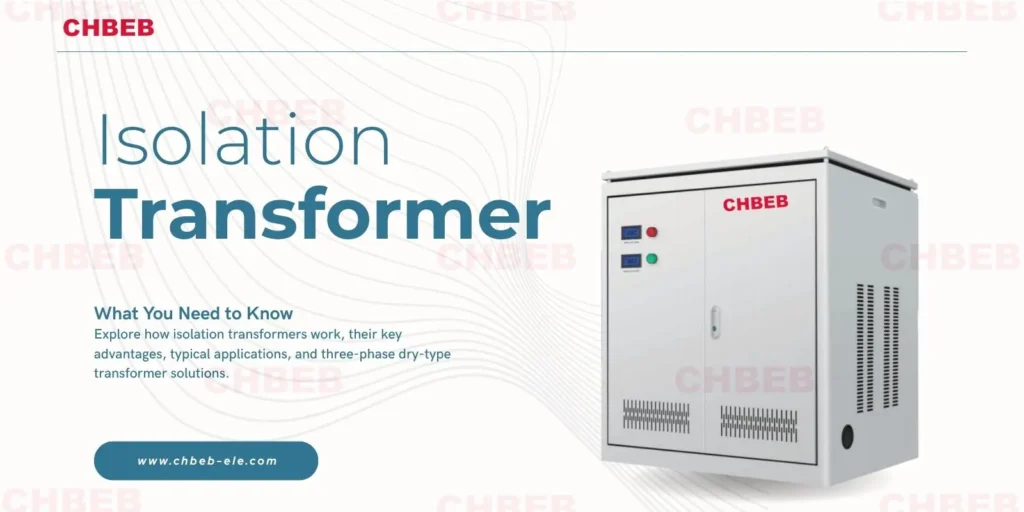
Three-phase dry-type isolation transformers are one of CHBEB’s flagship products. Manufactured with high-quality materials and advanced process technologies, they offer advantages such as moisture resistance and easy maintenance. They can be installed close to load centers and are suitable for power transmission and distribution applications in subways, high-rise buildings, airports, stations, ports, enterprises, tunnels, and other locations.
Three-phase dry-type isolation transformers not only provide voltage transformation in the power grid, but can also isolate third harmonics from the grid to the equipment, helping protect machines from overheating and reducing the impact on the service life of insulating materials. They are particularly suitable for imported equipment.
Available voltage configurations include 380 V input → 220 V output, 380 V input → any required output voltage, and 220 V input → any required output voltage. The capacity range is from 1 kVA to 1000 kVA, suitable for various AC 50–60 Hz power supply applications with voltages not exceeding 500 V.
Product input and output voltages, voltage levels, connection groups, tap positions, winding capacity distribution, secondary winding configuration, and whether an enclosure is required can all be carefully designed and manufactured according to customer requirements.
High-Quality Silicon Steel Sheets High-quality silicon steel cores produced by leading steel manufacturers in the industry are used. They are assembled with large-scale equipment using advanced processes, providing high magnetic permeability and lower core losses.
Pure Oxygen Coil Class H enameled wire is used, with specially wrapped conductors capable of withstanding temperatures up to 180°C, helping extend the service life of the equipment.
Corrosion-Resistant and Durable Metal structural components are treated with electroplating and baking paint processes, providing durability, corrosion resistance, and an attractive appearance.
Multi-Ventilation Design A multi-vent design combined with powerful fan cooling provides better transformer protection and helps extend service life.
CHBEB’s three-phase dry-type isolation transformers are suitable for AC 50–60 Hz circuits with voltages below 2000 V and can be widely used in precision machine tools, mechanical and electronic equipment, medical equipment, rectifier devices, lighting, and other applications. Product input and output voltages, connection groups, regulating taps, winding capacities, enclosure configurations, and other parameters can all be designed and manufactured according to actual application requirements.
A reliable dry-type isolation transformer depends not only on product parameters, but also on raw materials, design capabilities, manufacturing processes, and quality control. CHBEB GROUP has more than 60 years of transformer manufacturing experience and insists on using silicon steel sheets, copper wire, insulation materials, and electrical accessories supplied by high-quality industry suppliers. Through standardized winding, insulation treatment, assembly, and factory testing, quality is controlled throughout the entire production process.
Relying on its Beijing R&D center and production bases in Yueqing, Zhejiang and Nanjing, Jiangsu, CHBEB can provide transformer solutions covering product selection, technical design, and manufacturing according to the actual requirements of different countries, industries, and projects.
If you are looking for a three-phase dry-type isolation transformer suitable for your project, or have specific requirements for capacity, voltage, winding configuration, enclosure design, or other customized parameters, pleasecontact us. CHBEB can provide selection recommendations, technical solutions, and quotation support based on your actual application conditions and technical requirements, helping you determine a suitable transformer solution more efficiently.
FAQ
1. How do you choose the right capacity for a three-phase dry-type isolation transformer?
Before purchasing, first estimate the total capacity of the electrical equipment you will use, and select a transformer with the same capacity to ensure that the transformer will not be damaged during instantaneous startup.
2. What parameters should be checked before installing a three-phase dry-type isolation transformer?
Before installation, carefully check whether all data listed on the nameplate meet your requirements. Installation and use should only proceed after confirming that all information is correct.
3. What should you do if a three-phase dry-type isolation transformer becomes excessively hot or starts smoking?
After the transformer is energized, heating of the transformer core and coils is normal, provided that the temperature rise does not exceed 80°C. However, if the temperature rise is abnormal or the transformer begins to smoke, the power switch should be turned off and the capacitor capacity being used should be checked again.
4. What should be noted during transportation and use of a three-phase dry-type isolation transformer?
During transportation, impacts should be avoided as much as possible, and the transformer must not be exposed to moisture. During use, proper maintenance should be carried out to ensure the service life of the transformer.
5. Can a three-phase dry-type isolation transformer be customized?
Yes. Users can request customized special transformer products. The product dimensions may change accordingly or can be determined through consultation based on user requirements.
Hello! 👋 Welcome to CHBEB.
We are a transformer manufacturer with 60+ years of experience.
✅ Distribution & Power Transformers (Oil & Dry Type)
✅ Customized EPC & OEM Solutions
✅ Fast Delivery & International Certifications