Send us a message if you have any questions or request a quote. Our experts will give you a reply within 24 hours and help you select the right valve you want.
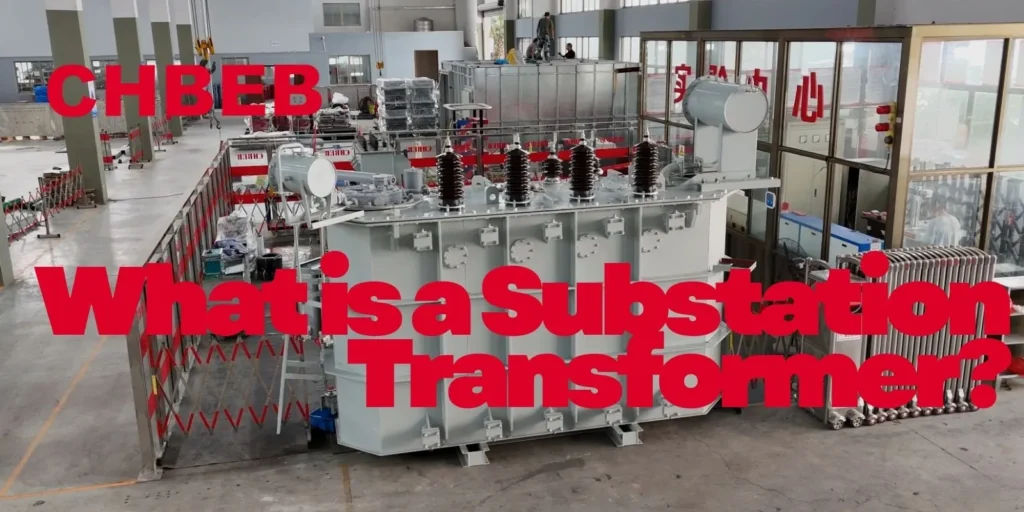
Substation Transformers are static electrical devices used in power systems to transform AC voltage, current, and impedance. Their core function is to step up the electrical energy generated by generators for long-distance transmission, or step it down for distribution to various electrical equipment. As a core part of the power network, power transformers are widely used in power transmission and distribution, industrial control, transportation, and building facilities.
CHBEB Group has focused on transformer production for 60 years. Its products cover various types of transformers, including oil-immersed transformers and dry-type transformers, meeting the needs of different applications such as industry, new energy, and power distribution. Click the link to learn more about our Substation Transformers.
Substation Transformer Overview
Substation Transformers are usually power transformers with their cores and windings completely immersed in insulating oil, using the insulating oil as the main insulation and cooling medium. As one of the most widely used types of transformers in power systems, they achieve voltage transformation through the principle of electromagnetic induction and are widely used in power generation, transmission, distribution, and industrial fields.
Oil-immersed Substation Transformers feature high heat dissipation efficiency, good insulation performance, and strong overload capacity, effectively addressing the heat dissipation and insulation challenges of large-capacity and high-voltage transformers.
1.Working Principle of Substation Transformers
Electromagnetic Induction: Electric current can generate magnetism, and electromagnetic force in a magnetic field can perform mechanical work. Conversely, magnetism can induce electric current, converting mechanical energy into electrical energy.
The formula shows that the voltage ratio of the primary and secondary windings of a transformer is equal to their turns ratio:
Transformer Working Principle Diagram
U₁ / U₂ = N₁ / N₂ = n
When n > 1, N₁ > N₂, therefore U₁ > U₂. This is a step-down transformer.
When n < 1, N₁ < N₂, therefore U₁ < U₂. This is a step-up transformer.
Therefore, by selecting different turns ratios between the primary and secondary windings of the transformer, the purpose of stepping up or stepping down the voltage can be achieved.
2.Structure of Substation Transformers
Although transformers come in many types and are used for different purposes, with different voltage levels and capacities, their basic structures are generally similar. The simplest transformer consists of a closed soft magnetic core and two mutually insulated windings wound around the core.
Basic Structure of Substation Transformers
Advantages of Substation Transformers
Substation Transformers usually use mineral oil as the insulating and cooling medium, with a high level of technological maturity. They offer excellent heat dissipation performance, as oil circulation efficiently carries away heat, making them suitable for long-term, high-power operation. They are commonly used in outdoor substations and industrial plants.
They also have a clear cost advantage, with lower prices than dry-type transformers of the same capacity, providing strong economic benefits. Their overload capability is relatively strong, and they offer high reliability during sudden load fluctuations. Main transformers in power grids commonly adopt this type of structure.
The disadvantages are mainly related to safety risks. Since oil is flammable, separate fire isolation areas are required during actual use, and application in underground spaces is limited.
Maintenance is relatively complex. The oil level, oil temperature, and oil quality need to be checked regularly, and oil leakage requires professional handling. Environmental protection requirements are strict, and waste oil disposal requires registration and documentation. Some sites also need to be equipped with oil collection pits and other protective facilities.
The transformer is also relatively heavy, requiring specialized equipment for transportation and installation.
Main Technical Parameters of Substation Transformers
The specifications, models, and main technical data of transformers are important references for transformer selection and use. The main technical data of a transformer include rated voltage, rated current, rated capacity, and temperature rise.
Rated Voltage: The rated voltage of the primary winding refers to the voltage value determined by the insulation strength of the insulating materials used in the transformer. The rated voltage of the secondary winding refers to the voltage measured across the secondary terminals under no-load conditions when the rated voltage is applied to the primary winding.
Rated Current: Refers to the maximum current allowed to flow through the primary and secondary windings under the specified permissible temperature rise conditions.
Rated Capacity: Indicates the maximum power that the transformer is allowed to transmit during operation. The unit is volt-ampere (VA).
Temperature Rise: Refers to the allowable temperature increase of the transformer above the ambient temperature during rated operation.
Insulation Temperature Class Reference Table
Insulation class
Y
A
E
B
F
H
C
Max operating temp (°C)
90
105
120
130
155
180
220
Substation Transformer Manufacturing Process
How to Choose a Reliable Substation Transformer Manufacturer
Substation Transformers are core equipment in power systems, undertaking the key tasks of voltage conversion, power distribution, and transmission. Whether in urban grid construction, industrial power supply, or renewable energy generation, stable and reliable transformer support is essential. Choosing the right power transformer supplier is not only related to equipment performance, but also directly affects the safety and economic efficiency of the power system. So, how can you choose a truly reliable transformer manufacturer? As a transformer manufacturer with more than 60 years of transformer production history, CHBEB GROUP has summarized the following standards based on our experience and practice.
1. Authoritative Qualifications and Certifications
A reliable transformer manufacturer must first operate legally and in compliance with relevant regulations and obtain recognition from authoritative certification systems. These qualifications are important evidence of a company’s strength and product quality, and are also a prerequisite for entering the bidding process for key projects.
CHBEB GROUP has advanced production and testing equipment, complete testing processes, and a modern management system, while continuously pursuing innovation and development. We have obtained ISO 9001 Quality Management System Certification, ISO 14000 Environmental Management System Certification, ISO 45001 Occupational Health and Safety Management System Certification, CE Conformity Report, Low Voltage Directive Conformity, and GOST Declaration of Conformity, to meet the requirements of different markets and projects.
CHBEB Qualifications and Certifications
2. Technical Strength and Innovation
The technical advancement of a transformer directly affects the operating efficiency and stability of a project over the coming decades. A reliable manufacturer must have strong technical expertise and advanced product support.
As a National High-Tech Enterprise, CHBEB GROUP holds certification from the National Transformer Quality Supervision and Inspection Center, CCC certification, 5 invention patents, and more than 120 patent certifications.
We provide high-quality products and solutions for State Grid Corporation of China and for industries around the world, including power, metallurgy, steel, petrochemical, machinery manufacturing, and pharmaceuticals.
Over 60 years of development, CHBEB GROUP has established its Beijing headquarters as the center of technical research and development, with three major production industrial parks in Nanjing, Jiangsu and Yueqing, Zhejiang. The company specializes in the production of transformers, prefabricated substations, wind power substations, solar photovoltaic substations, high- and low-voltage complete sets of equipment, ring main units, pole-mounted outdoor circuit breakers, outdoor vacuum circuit breakers, power transmission and distribution supporting equipment, as well as power engineering contracting and installation.
3. Manufacturing Quality and Standards
A high-quality transformer product depends not only on reliable raw materials, but also on strict control over every production process.
CHBEB has always attached great importance to quality control throughout the entire production process and insists on cooperating with leading raw material suppliers in the industry. From silicon steel sheets, copper wire, and insulating materials to transformer electrical accessories, product quality and stability are ensured from the source.
In terms of manufacturing processes, automatic winding equipment is used for the windings, with strict control over winding dimensions and conductor arrangement. The double vacuum casting process can effectively remove air bubbles and moisture from the coils, greatly improving the insulation strength of the transformer. During assembly, strict operating procedures are followed to ensure a proper fit between the coils and core, flat stacking of silicon steel sheets, and correct connections of leads, bushings, and switches.
During final inspection, every CHBEB product undergoes rigorous quality testing. Key tests such as no-load and load tests, partial discharge tests, and lightning impulse tests are strictly controlled.
From the use of new raw materials and components to manufacturing and final testing, CHBEB controls quality at every stage to provide customers with stable and reliable transformer products.
CHBEB Transformer Production Workshop
Why Choose CHBEB for Substation Transformers
Choosing a transformer manufacturer is essentially an investment in the stable operation of a project for decades to come. Qualifications and certifications are the entry threshold, technical strength determines long-term product performance, and manufacturing quality is the fundamental guarantee of reliability—all three are indispensable.
CHBEB GROUP has been deeply engaged in the transformer industry for more than 60 years. With ISO management system certifications and international certifications such as CE and GOST as the foundation for compliance, National High-Tech Enterprise qualification, 5 inventions, and more than 120 patents demonstrate our technical strength. At the same time, strict processes such as automatic winding and double vacuum casting, together with full-process quality control, ensure that every product can withstand the test of time and operating conditions. From the Beijing R&D center to the three production bases in Nanjing and Yueqing, we have provided stable and reliable products and solutions for State Grid Corporation of China and customers in the global power, metallurgy, petrochemical, and other industries.
If you are looking for a trustworthy transformer partner, welcome to contact CHBEB GROUP. Our professional technical team can provide customized selection recommendations and solutions for your project.
Hello! 👋 Welcome to CHBEB.
We are a transformer manufacturer with 60+ years of experience.
✅ Distribution & Power Transformers (Oil & Dry Type)
✅ Customized EPC & OEM Solutions
✅ Fast Delivery & International Certifications